
Difference Between Acne and Fungal Acne: How to Tell Them Apart
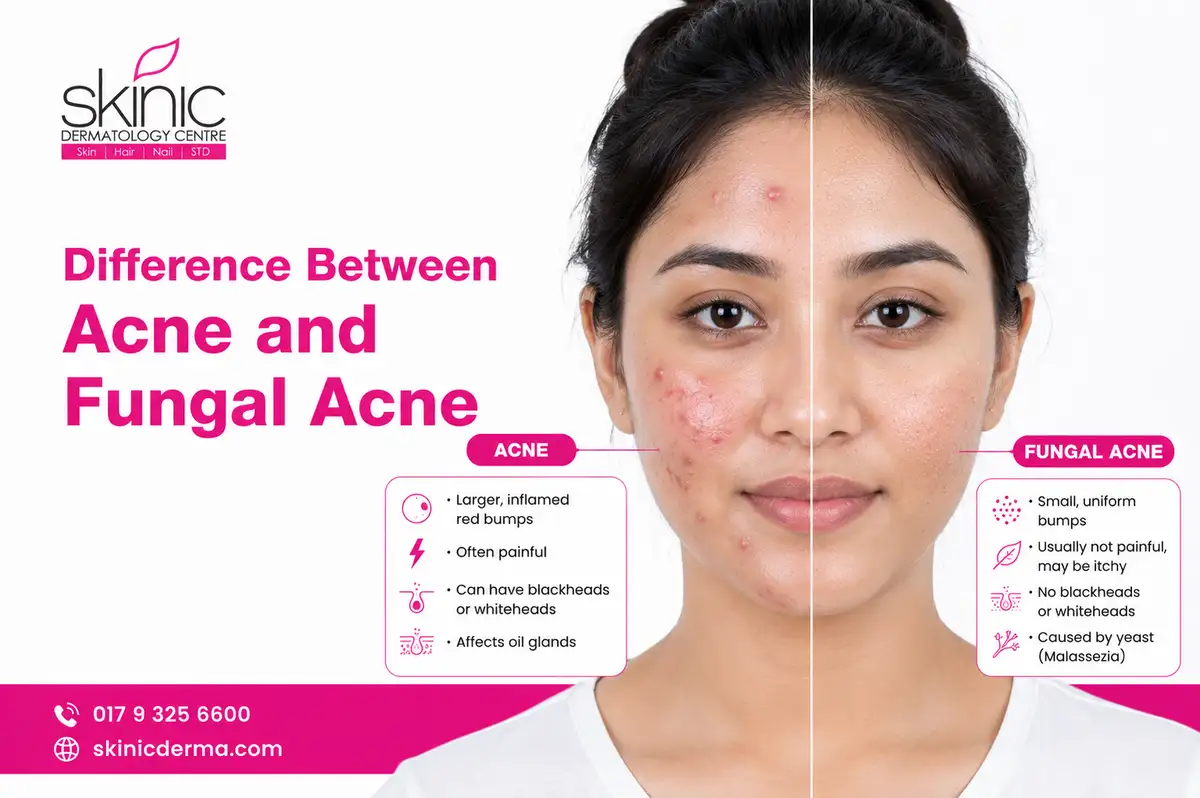
Small bumps on your forehead, cheeks, chest, or back can easily make you think, “This must be acne.” In many cases, it is. But not every acne-like breakout is actually acne.
One condition that is commonly mistaken for regular acne is what people often call fungal acne. Despite the name, fungal acne is not technically acne at all. The medical term is Malassezia folliculitis, a condition caused by an overgrowth of Malassezia yeast around the hair follicles.
The confusing part is that acne and Malassezia folliculitis can look very similar. What causes them, however, is quite different, and so is the way they are treated. That is why someone with fungal acne may keep trying conventional acne products without seeing much improvement.
Knowing the difference can save you a great deal of frustration, unnecessary skincare products, and months of trial and error.
This distinction can be especially useful for people living in Dhaka and other parts of Bangladesh. Hot weather, high humidity, heavy sweating, and occlusive clothing can all create conditions that contribute to certain follicular skin problems.
If your breakouts keep coming back even though you are following your usual acne routine, it may be worth taking a closer look at what is actually causing them.
What Is Regular Acne?
Regular acne, or acne vulgaris, is an inflammatory skin condition that affects the hair follicles and sebaceous glands, which are responsible for producing skin oil.
Acne usually develops because several factors are happening at the same time, including:
- Excess production of sebum or skin oil
- Build-up of dead skin cells inside the pores
- Blocked hair follicles
- Growth of acne-associated bacteria
- Inflammation
- Hormonal influences
Acne does not always look the same. Depending on the type and severity, you may notice several different kinds of lesions.
Common types of acne include:
Whiteheads: Closed, clogged pores that appear as small white or flesh-coloured bumps.
Blackheads: Open clogged pores that develop a dark surface because of oxidation.
Papules: Small, red, inflamed bumps.
Pustules: Inflamed pimples with visible pus.
Nodules: Larger, deeper lumps beneath the skin that are often painful.
Cysts: Deep inflammatory lesions that may be painful and have a greater risk of leaving scars.
For a more detailed look at the causes, types, and available management options, you can read our other blog, Complete Guide to Acne Treatment in Dhaka.
Schedule an Appointment
What Is Fungal Acne?
“Fungal acne” is the commonly used name for Malassezia folliculitis.
Malassezia is a type of yeast that naturally lives on human skin. Simply having this yeast on your skin does not mean anything is wrong.
Problems may develop when certain environmental or individual factors allow Malassezia to multiply excessively around the hair follicles. This can trigger inflammation and lead to clusters of small bumps that resemble ordinary pimples.
That similar appearance is the main reason Malassezia folliculitis is so often confused with acne vulgaris.
Factors commonly associated with Malassezia folliculitis include:
- Hot and humid weather
- Heavy sweating
- Oily skin
- Occlusive clothing
- Certain oily or occlusive skincare products
- Previous antibiotic use
- Some medications or conditions that affect the immune system
Because Dhaka remains warm and humid for much of the year, it can be particularly important to distinguish between ordinary acne and other acne-like eruptions.
We also discussed the relationship between Bangladesh’s climate and breakouts in our guide on what causes acne in humid weather like Bangladesh.
Acne vs Fungal Acne: Quick Comparison
| Feature | Regular Acne | Fungal Acne |
| Medical name | Acne vulgaris | Malassezia folliculitis |
| Main mechanism | Clogged follicles, sebum, and inflammation | Overgrowth of Malassezia yeast in the follicles |
| Appearance | Lesions often vary in type and size | Usually many small, similar-looking bumps |
| Blackheads | Common | Usually absent |
| Whiteheads | Can occur | Typical acne comedones are usually absent |
| Itching | Usually not the main symptom | Can be quite noticeable |
| Common locations | Face, jawline, shoulders, chest, and back | Forehead/hairline, chest, upper back, neck, and sometimes arms |
| Response to ordinary acne treatment | Often improves with appropriate acne therapy | May continue if treated only as acne |
| Treatment approach | Acne-specific medications and skincare | Antifungal treatment when appropriately diagnosed |
These differences can give you useful clues, but appearance alone is not always enough to make an accurate diagnosis.
7 Important Differences Between Acne and Fungal Acne
1. They Develop for Different Reasons
The biggest difference begins with what is actually happening inside the skin.
Acne vulgaris develops through a combination of excess sebum, abnormal shedding of skin cells, clogged follicles, microorganisms, and inflammation.
Fungal acne, or Malassezia folliculitis, develops when Malassezia yeast grows excessively within the hair follicles.
Because the underlying causes are different, using the same treatment for both conditions may not work.
2. Fungal Acne Bumps Often Look Very Similar
With regular acne, it is common to see several different kinds of spots at once.
For example, you might have:
- Two blackheads
- A few small whiteheads
- Several red pimples
- One larger, painful bump
All of these can appear at the same time.
Fungal acne is often more uniform. Dermatologists may describe this as a monomorphic eruption, meaning that many of the bumps look almost the same in size and appearance.
Instead of a mixture of different acne lesions, you may see a cluster of dozens of small, similar-looking bumps.
3. Itching Can Be an Important Clue
Itchiness is one of the more useful clues when trying to distinguish acne from fungal acne.
Ordinary acne can sometimes feel sore, tender, or irritated, especially when the spots are inflamed. Strong itching, however, is not usually one of its main features.
Malassezia folliculitis can be noticeably itchy.
So, if you suddenly develop a group of similar-looking bumps that itch, particularly across the forehead, chest, or upper back, it may be worth having them assessed properly.
That said, itching on its own does not confirm fungal acne. Several other skin conditions can also cause itchy bumps.
4. Blackheads and True Comedones Suggest Regular Acne
Blackheads and whiteheads are forms of comedonal acne.
They form when sebum, dead skin cells, and other material accumulate inside the follicle.
Typical comedones are generally not seen in Malassezia folliculitis. This means that obvious blackheads, especially when they appear alongside other types of pimples, make acne vulgaris more likely.
There is one complication: a person can have more than one skin condition at the same time. Someone may have acne and Malassezia folliculitis together, which can make self-diagnosis much harder.
5. They Can Appear in Different Areas
Acne vulgaris commonly develops in areas where there are plenty of sebaceous glands, including the:
- Forehead
- Nose
- Cheeks
- Chin
- Jawline
- Chest
- Shoulders
- Back
Malassezia folliculitis is commonly seen around the:
- Forehead and hairline
- Upper chest
- Upper back
- Neck
- Shoulders
- Upper arms
The chest and upper back are particularly common areas for Malassezia folliculitis.
Location can provide another useful clue, but it should never be considered on its own. The appearance of the bumps and other symptoms matter as well.
6. Heat, Humidity, and Sweating May Be Particularly Relevant
Anyone who lives in Dhaka knows how quickly hot, humid weather can lead to sweating.
Warm and moist conditions can favour the growth of Malassezia. Sweat combined with tight or poorly breathable clothing can also keep heat and moisture trapped against the skin.
Some people may notice more bumps after:
- Exercising
- Spending long periods outdoors in hot weather
- Staying in sweaty clothes for several hours
- Applying very occlusive skincare products
- Frequently wearing tight synthetic clothing
Humidity can also make ordinary acne worse by increasing sweating, oiliness, and occlusion. So weather alone cannot tell you whether you have acne or Malassezia folliculitis.
We explain this relationship in more detail in our article on acne and humid weather in Bangladesh.
7. The Treatment Is Different
From a practical point of view, this may be the most important difference.
Regular Acne Treatment
Depending on the type and severity of acne, a dermatologist may consider treatments such as:
- Topical retinoids
- Benzoyl peroxide
- Azelaic acid
- Salicylic acid-containing products
- Prescription topical treatments
- Oral medications for selected patients
- Procedures for acne or acne scars
The right treatment depends on several factors, including the type of acne, its severity, your skin sensitivity, and your medical history.
For a broader overview of acne treatment, see Skinic’s guide on how to get rid of acne.
Fungal Acne Treatment
Malassezia folliculitis is caused by a different mechanism from acne vulgaris, so the treatment approach is different as well.
After evaluating the condition, a dermatologist may recommend an appropriate topical antifungal treatment or, in selected cases, an oral antifungal medication.
This is why applying stronger and stronger acne products to every small bump can become frustrating.
If the diagnosis is incorrect, the treatment may be inappropriate too.
Schedule an Appointment
Why Can Fungal Acne Be Confusing in Bangladesh?
Bangladesh’s tropical climate creates several conditions that can contribute to acne-like skin problems.
In Dhaka, the skin may regularly be exposed to a combination of:
- Heat
- High humidity
- Sweat
- Dust
- Pollution
- Long commutes
- Layers of sunscreen and skincare products
- Tight or occlusive clothing
Because of this, someone may naturally assume that every breakout is simply the result of oily skin, sweating, or pollution.
However, bumps that are unusually uniform, persist for a long time, and feel noticeably itchy may deserve a closer dermatological examination.
This does not mean that every breakout during the summer or monsoon season is fungal acne. Regular acne, bacterial folliculitis, heat rash, contact reactions, and other skin conditions can also cause small bumps.
The important thing is to identify what you are actually dealing with rather than choosing a product simply because the label says “for acne.”
Can You Have Acne and Fungal Acne at the Same Time?
Yes, you can.
Acne vulgaris and Malassezia folliculitis can occur together.
For example, someone might have blackheads and inflamed acne on the cheeks while also developing clusters of itchy, follicular bumps across the forehead or chest.
This can make the problem particularly confusing. Part of the breakout may improve with ordinary acne treatment while another part remains unchanged.
A dermatologist can look at the overall pattern and determine whether one or more skin conditions may be present.
How Does a Dermatologist Diagnose Fungal Acne?
Diagnosis usually starts with a careful examination of the skin.
A dermatologist may consider:
- The size and appearance of the bumps
- Whether blackheads or whiteheads are present
- Whether the area is itchy
- Where the lesions are located
- How quickly they appeared
- Whether heat or sweating makes them worse
- The skincare products you currently use
- Your medication history
- Previous acne treatments
- How your skin has responded to antibiotics or other medication
If the diagnosis is still unclear, further dermatological examination or testing may sometimes be used to help distinguish Malassezia folliculitis from acne and other forms of folliculitis.
This is generally far more reliable than trying to identify a skin condition by comparing your breakout with photos on social media.
Common Mistakes People Make With Fungal Acne
Treating Every Bump as Ordinary Acne
Not every small bump is caused by a clogged pore.
Trying one acne product after another without knowing what you are treating may irritate your skin while doing little to address the actual problem.
Scrubbing the Skin Too Aggressively
Scrubbing harder will not remove fungal acne.
In fact, excessive scrubbing and exfoliation can weaken the skin barrier, increase sensitivity, and make redness or inflammation worse.
Squeezing the Bumps
Whether the problem is acne or folliculitis, picking and squeezing the skin can cause damage.
It may increase inflammation and can contribute to marks or scarring.
Using Someone Else’s Prescription
Two skin conditions can look almost identical while having completely different causes.
Prescription medication should only be used when it is appropriate for your individual skin condition.
Taking Antibiotics Without Medical Advice
Antibiotics are not suitable for every acne-like breakout, and unnecessary antibiotic use can create additional problems.
If your bumps seem unusual or keep returning, it is better to have the condition diagnosed properly than to keep changing medication yourself.
Schedule an Appointment
Skin-Care Habits That May Help Reduce Breakouts in Dhaka
Skincare cannot replace treatment when there is an underlying medical condition. However, a few practical habits may help support healthier skin.
Cleanse Gently
Use a gentle cleanser suited to your skin type to remove sweat, excess oil, sunscreen, and pollution.
Try not to wash your face repeatedly throughout the day simply because it feels oily. Over-cleansing may irritate the skin.
Shower After Heavy Sweating
After exercise or heavy sweating, change out of damp gym clothes or other sweaty clothing when possible.
Leaving moist clothing against the skin for hours can create an uncomfortable, occlusive environment.
Choose Skincare Products Carefully
Very heavy, greasy, or highly occlusive products may not suit everyone with acne-prone skin, especially during hot and humid weather.
Instead of building your routine around social-media trends, consider choosing products according to your actual skin condition.
A dermatologist can help with this if needed.
Avoid Excessive Exfoliation
Using more acids, scrubs, or exfoliating treatments does not necessarily lead to clearer skin.
Once the skin barrier becomes irritated, existing redness, sensitivity, and discomfort may become worse.
Do Not Pick Your Skin
Repeatedly squeezing pimples can increase inflammation and contribute to post-acne marks and scars.
If acne has already caused scarring, Skinic also has a detailed guide to the best treatment options for acne scars.
When Should You See a Dermatologist?
It may be a good idea to consult a dermatologist if:
- Your breakout is intensely itchy
- Most of the bumps are almost identical in size
- The problem keeps returning
- Standard acne products are not helping
- The breakout is becoming painful or widespread
- You are developing dark marks or scars
- Your chest or back is heavily affected
- Your skin became worse after starting a medication
- You are unsure whether you have acne, folliculitis, or another skin condition
Severe, painful, or rapidly worsening skin symptoms should also be assessed professionally rather than diagnosed at home.
Acne and Fungal Acne Treatment in Dhaka
If acne-like bumps are not improving, the answer is not always to look for a stronger cream.
The first priority should be finding out what is actually causing the breakout.
Skinic Dermatology Centre, located in Mirpur DOHS, Dhaka, provides clinical dermatology care, including the assessment and management of acne and other skin conditions.
People dealing with persistent acne can also learn more about the clinic’s dedicated acne treatment services.
A personalised dermatological assessment can help distinguish between:
- Acne vulgaris
- Malassezia folliculitis
- Other types of folliculitis
- Irritation or contact reactions
- Other acne-like skin disorders
Once the diagnosis is clearer, a suitable treatment plan can be selected based on the patient’s skin type, symptoms, and medical needs.
Final Thoughts
Acne and fungal acne may look similar at first glance, but the most important difference is not simply the appearance of the bumps. It is what is causing them.
Regular acne develops through clogged follicles, excess sebum, and inflammation. Fungal acne, or Malassezia folliculitis, involves an overgrowth of yeast around the hair follicles.
There are a few clues that can help:
- A mixture of pimples, blackheads, and whiteheads is more suggestive of ordinary acne.
- Large numbers of very similar-looking bumps may point towards Malassezia folliculitis.
- Noticeable itching can make fungal acne more suspicious.
- Heat, humidity, and heavy sweating may aggravate Malassezia folliculitis.
- Breakouts that persist despite appropriate acne treatment deserve further assessment.
Most importantly, try not to treat your skin based only on what a breakout looks like.
If your “acne” keeps returning despite changing cleansers, serums, spot treatments, and other products, you may not need another skincare product. You may need a more accurate diagnosis.
For persistent acne or acne-like breakouts in Dhaka, a dermatologist at Skinic Dermatology Centre can assess your skin and recommend an individualised treatment approach.
Getting the diagnosis right is the first step towards choosing the right treatment.
Frequently Asked Questions About Acne vs Fungal Acne
1. Is fungal acne really a fungus?
The name “fungal acne” can be a little misleading. The condition usually refers to Malassezia folliculitis, which involves Malassezia yeast around the hair follicles. It is different from acne vulgaris.
2. What does fungal acne usually look like?
It often appears as clusters of small, fairly uniform bumps or pustules around the hair follicles. These may develop on the forehead, hairline, chest, or upper back and can be itchy.
3. How can I tell whether I have acne or fungal acne?
Blackheads, whiteheads, and a mixture of different-sized lesions are more typical of acne vulgaris. Malassezia folliculitis more often causes similar-sized, itchy bumps without typical comedones.
4. Does fungal acne itch?
Itching is commonly associated with Malassezia folliculitis and can be an important clue. Ordinary acne may feel sore or tender, but noticeable itching is less characteristic.
5. Can fungal acne cause blackheads?
Typical blackheads or comedones are not characteristic of Malassezia folliculitis. If blackheads are clearly present, regular acne becomes more likely.
6. Can fungal acne occur on the forehead?
Yes. The forehead and hairline are common areas for Malassezia folliculitis.
It may also affect the chest, upper back, neck, and shoulders.
7. Is fungal acne common in humid weather?
Hot and humid conditions, along with heavy sweating, are recognised risk factors for Malassezia folliculitis. That makes proper identification particularly relevant for people living in tropical climates such as Bangladesh.
8. Can ordinary acne products cure fungal acne?
Not necessarily. Acne vulgaris and Malassezia folliculitis develop through different mechanisms. A treatment that works well for regular acne may therefore not be suitable for fungal acne.
9. Should I stop all my acne products if I think I have fungal acne?
Do not suddenly stop prescribed treatment based only on self-diagnosis. Speak with a qualified dermatologist who can evaluate the breakout and advise you about which products should be continued, changed, or stopped.
Book Your Appointment
Appointment will be confirmed over phone as per the available time slot of our consultant.